
Extractor Fan Troubleshooter
Select the symptoms you are experiencing to find out who to call and estimated costs.
Please select a symptom above to get recommendations.
You flip the switch, but your extractor fan just hums quietly or stays completely silent. It’s a frustrating moment, especially when steam is rising from your pasta water and the bathroom mirror is already fogging up. The immediate question that hits most homeowners isn't "how do I fix this?" but rather, "who do I call to fix this?" Should you hire an electrician? A plumber? Or can your local handyman handle it?
The answer depends entirely on what’s actually broken. Unlike a boiler or a washing machine, which have very specific trades assigned to them, extractor fans sit in a weird gray area of home maintenance. They involve electricity, ductwork, and sometimes plumbing (if they vent through a wall). Getting the wrong person out to your house wastes time and money. This guide breaks down exactly which trade handles which part of the problem, so you don’t end up paying for a service call when you could have solved it yourself.
Key Takeaways: Who Fixes What?
- Electrical Issues: If the fan won’t turn on, has no power, or sparks, call a licensed electrician.
- Mechanical/Cleaning: If the fan is noisy, slow, or clogged with grease, a handyman or DIY approach works best.
- Ductwork/Ventilation: If air isn’t exiting properly or smells back into the room, a HVAC technician or specialist ventilation installer is needed.
- Installation: New installs usually require an electrician for wiring compliance, even if a handyman mounts the unit.
The Electrical Side: When You Need an Electrician
Most people assume any electrical appliance repair needs an electrician. For extractor fans, this is true about 40% of the time. An electrician is required whenever the issue involves the flow of current to the unit. If you press the switch and hear absolutely nothing-no hum, no click, no light-the problem is likely upstream. It could be a tripped circuit breaker, a faulty wall switch, or a burned-out motor winding inside the fan housing.
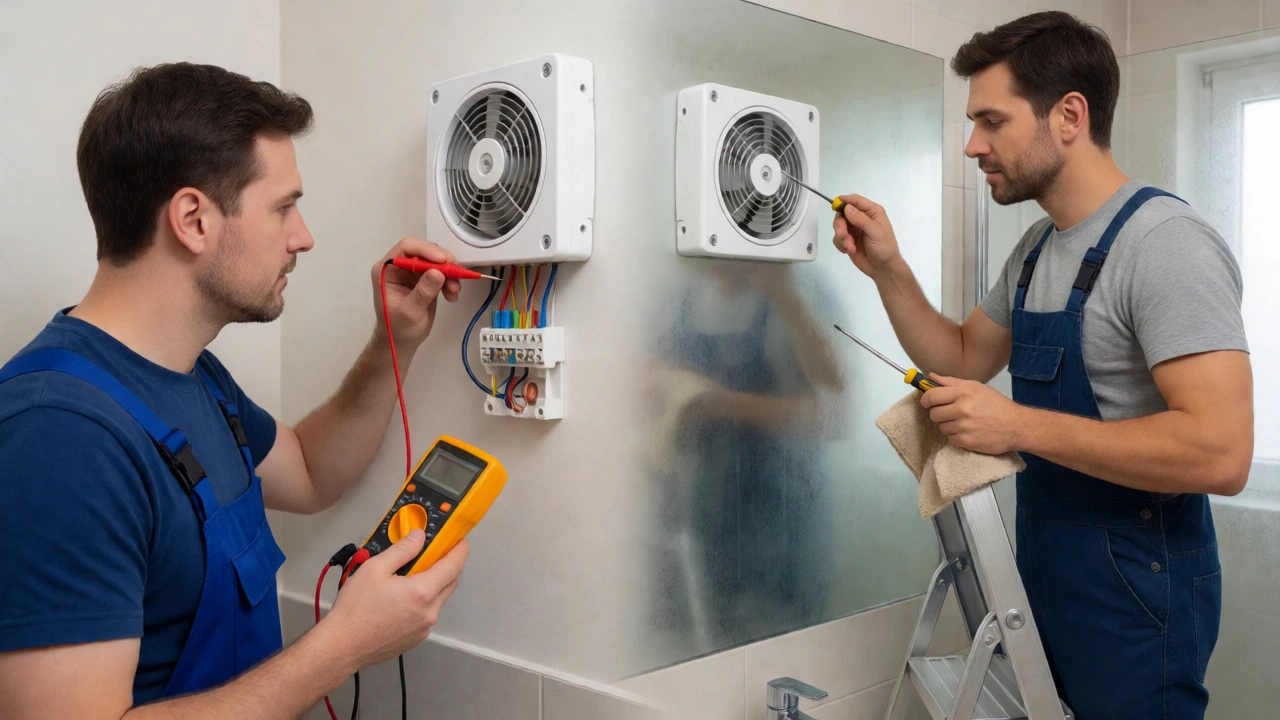
In many regions, working on fixed wiring (the cables running through your walls and ceiling) requires a certified professional. This isn’t just about skill; it’s about insurance and code compliance. If an unqualified person messes with the junction box behind the fan and causes a fire later, your home insurance might not cover it. So, if the fan is dead, start by checking your consumer unit (fuse box). If the breaker is fine, call an electrician. They will test the continuity of the switch and the voltage at the terminal block. Often, replacing a worn-out capacitor-a small component that helps the motor start-is a quick job for them, costing far less than a full replacement.
The Mechanical Side: Handyman vs. DIY
If the fan runs but sounds like a jet engine taking off, or if it barely moves any air, you probably don’t need an electrician. These are mechanical issues. Grease buildup in kitchen extractors is notorious for slowing down impellers. Bathroom fans collect dust and mold, which weighs down the blades and strains the motor.
This is where a handyman shines. Handymen are generalists who understand basic mechanics and mounting. They can safely remove the fan cover, clean the internal components, lubricate bearings, and reassemble the unit. If the fan wobbles violently, it might be loose from its mounting bracket. A handyman can tighten screws, replace rubber grommets, or secure the unit more firmly to the joists.
Can you do this yourself? Absolutely. If you’re comfortable using a screwdriver and a vacuum cleaner, cleaning a bathroom fan is a 15-minute job. However, kitchen fans are different. Removing the grease filters is easy, but accessing the motor often requires dropping the entire housing from the ceiling. If you aren’t confident working above your head while balancing on a ladder, hire the handyman. Their hourly rate is significantly lower than an electrician’s, making them the cost-effective choice for physical repairs and cleaning.
Ventilation and Ductwork: The HVAC Specialist
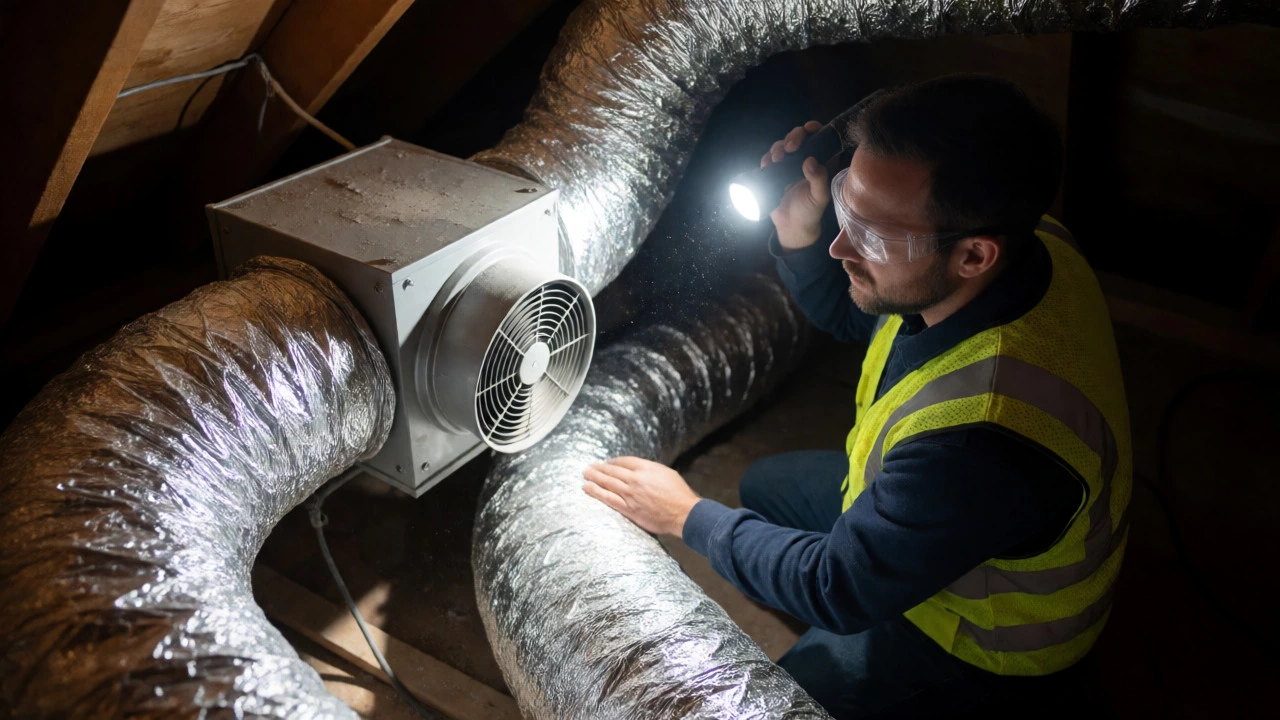
Sometimes the fan spins perfectly, but the room still feels stuffy. This indicates a problem with the exhaust path. Your extractor fan doesn’t just push air; it relies on a clear route to the outside. If the flexible ducting has collapsed, kinked, or disconnected, the air just recirculates or dumps into the attic space.
While handymen can reconnect a simple plastic clip, complex ductwork issues belong to HVAC technicians or dedicated ventilation specialists. They assess airflow rates (measured in liters per second) and static pressure. If your duct run is too long or has too many bends, the fan might be underpowered for the task. An HVAC pro can calculate if you need a booster fan or a larger diameter duct. They also ensure the external vent flap opens correctly against wind pressure. If birds’ nests or debris block the exterior grille, they’ll clear it and install proper guards.
Comparing Trades: Cost and Scope
Choosing the right trade saves you money. Here is a breakdown of typical scopes and relative costs based on standard UK/EU market rates as of 2026.
| Trade | Best For | Typical Hourly Rate* | DIY Risk Level |
|---|---|---|---|
| Electrician | No power, wiring faults, new installations, motor replacement involving live terminals. | £50 - £80 | High (Shock/Fire) |
| Handyman | Cleaning, noise reduction, loose mounting, filter replacement, minor mechanical jams. | £30 - £50 | Low (Mess/Fall) |
| HVAC Specialist | Poor airflow, ductwork leaks, complex ventilation systems, humidity control issues. | £60 - £90 | Medium (Inefficiency) |
| Plumber | Rarely involved, unless the fan shares a wet-wall cavity with pipes causing condensation damage. | £45 - £70 | N/A |
Common Misconceptions About Extractor Fan Repairs
One big myth is that all extractor fans are the same. They aren’t. There are inline fans (hidden in the loft), axial fans (mounted directly in the window or wall), and centrifugal fans (common in kitchens). Knowing which type you have changes who you call.
Inline fans are harder to access. If the motor fails in an inline unit located in a cramped attic, you might need two people-one to hold the ladder and one to work. Handymen often refuse these jobs if the access panel is tiny. In these cases, a specialist ventilation engineer is better equipped because they carry specific tools for tight spaces and know how to dismantle inline casings without breaking the plastic clips.
Another misconception is that you must replace the whole unit if it stops working. Often, it’s just a thermal cut-out fuse inside the motor that trips when the fan overheats due to dirt. Cleaning the fan resets this. Replacing the entire unit costs £40-£100 plus labor. Cleaning costs £30-£50 in labor. Always try the cheap fix first.
When to Replace Instead of Repair
How old is your fan? Most budget extractor fans have a lifespan of 5-7 years. Premium models last 10-15. If your fan is over 10 years old and the motor is failing, repairing it rarely makes financial sense. Replacement motors often cost nearly as much as a new unit, and finding parts for obsolete models can take weeks.
Consider the energy efficiency rating too. Older fans consume more power and move less air. A modern EC-motor fan uses 50% less electricity and operates much quieter. If you’re calling an electrician anyway, ask them to quote for installation of a new unit. The difference between a repair bill and a new install price might be negligible once you factor in improved performance and lower energy bills.
Preventing Future Breakdowns
You can avoid most callouts with minimal effort. Kitchen fans need their metal filters washed every month. Use hot soapy water or put them in the dishwasher if they fit. Bathroom fans should be wiped down quarterly to prevent mold buildup on the blades. Check the external vent flap once a year to ensure it’s not stuck shut by paint or rust.
If you notice the fan running constantly, check your timer switch. Sometimes the internal spring mechanism wears out, keeping the fan on indefinitely. This burns out the motor faster. Replacing a timer switch is a cheap electrical job, but leaving it alone leads to a full motor failure.
Frequently Asked Questions
Can I fix an extractor fan myself if it won't turn on?
You can check the obvious things: make sure the isolator switch (usually near the fan or in the cupboard) is on, and check your consumer unit for a tripped breaker. However, if those are fine, testing the motor requires a multimeter and knowledge of live circuits. Unless you are qualified, stop there and call an electrician to avoid shock hazards.
Why does my extractor fan smell bad when running?
A bad smell usually means stagnant water or mold inside the ducting, or a blocked external vent allowing wind to blow odors back in. Clean the fan housing and check the external flap. If the smell persists, an HVAC specialist may need to inspect the duct run for leaks or condensation pooling.
Is it cheaper to repair or replace an extractor fan?
For fans under 5 years old, repair is usually cheaper. For fans over 7-10 years old, replacement is often better value because parts are scarce, labor costs accumulate, and new units are more energy-efficient and quieter. Always get a quote for both options before agreeing to work.
Do I need planning permission to install a new extractor fan?
Generally, no, unless you live in a listed building or a conservation area. Standard internal replacements don’t require permission. However, if you are cutting a new hole in an external wall, check with your local council, especially if you live in a flat, as leasehold agreements may restrict alterations to the façade.
What causes an extractor fan to make loud noises?
Loud rattling is usually loose mounting brackets or debris hitting the blades. Grinding suggests worn bearings in the motor. High-pitched whining often indicates the motor is struggling against heavy grease buildup. Cleaning usually solves the rattle and whine; grinding often means the motor is dying and needs replacement.